AI Analytics for Building & HVAC Data
Upload Excel or CSV exports from your BMS and let an LLM-powered analytics engine surface trends, benchmark chillers and AHUs against ASHRAE 90.1, flag anomalies, and prioritise energy-saving actions — in minutes rather than weeks of manual analysis.
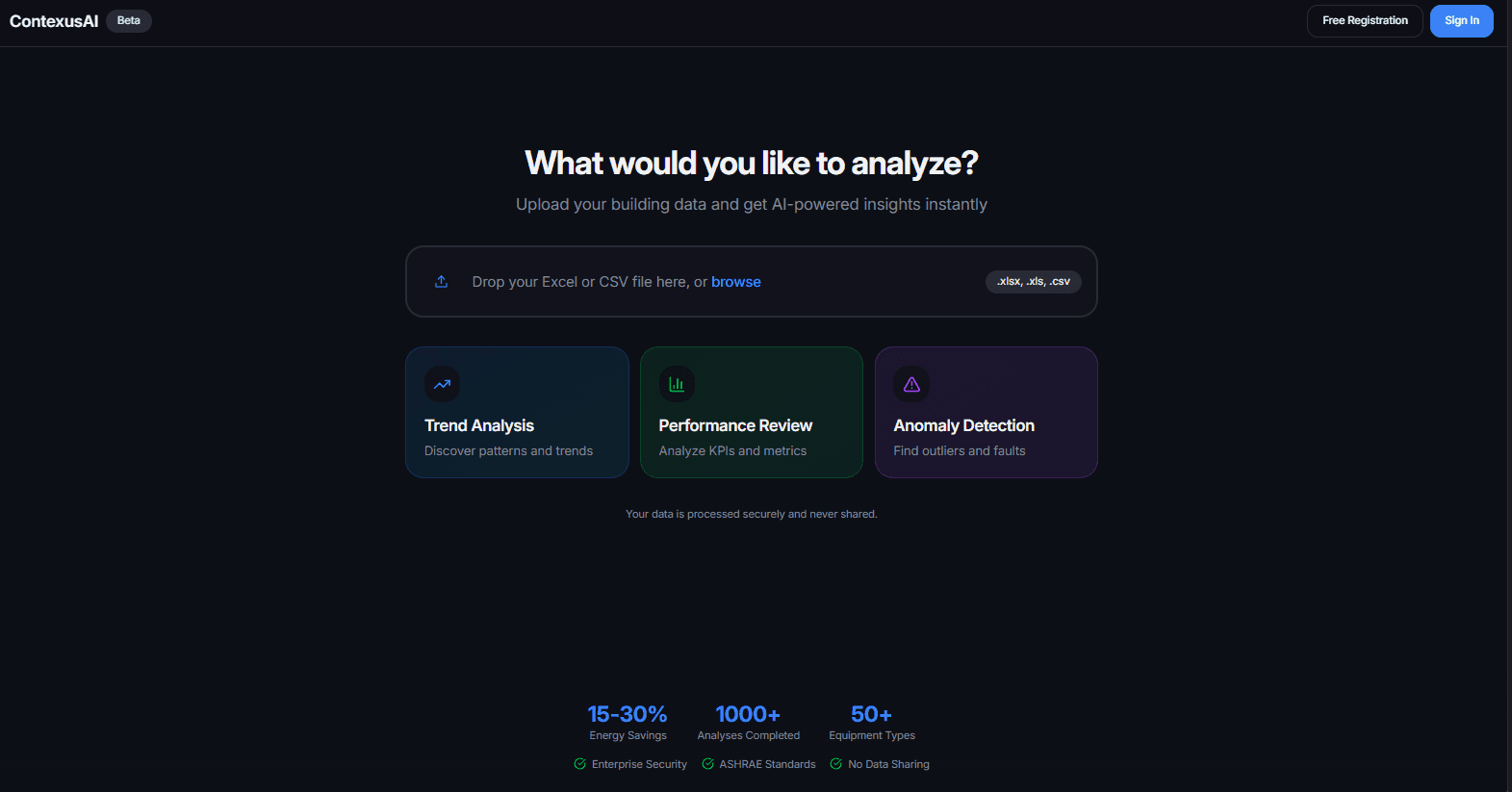
What would you like to analyse?
Upload your building data and get AI-powered insights instantly
Trend Analysis
Discover patterns and trends
Performance Review
Analyse KPIs and metrics
Anomaly Detection
Find outliers and faults
Your data is processed securely and never shared.
Energy Savings Identified
Analyses Completed
Equipment Types
AI Insights
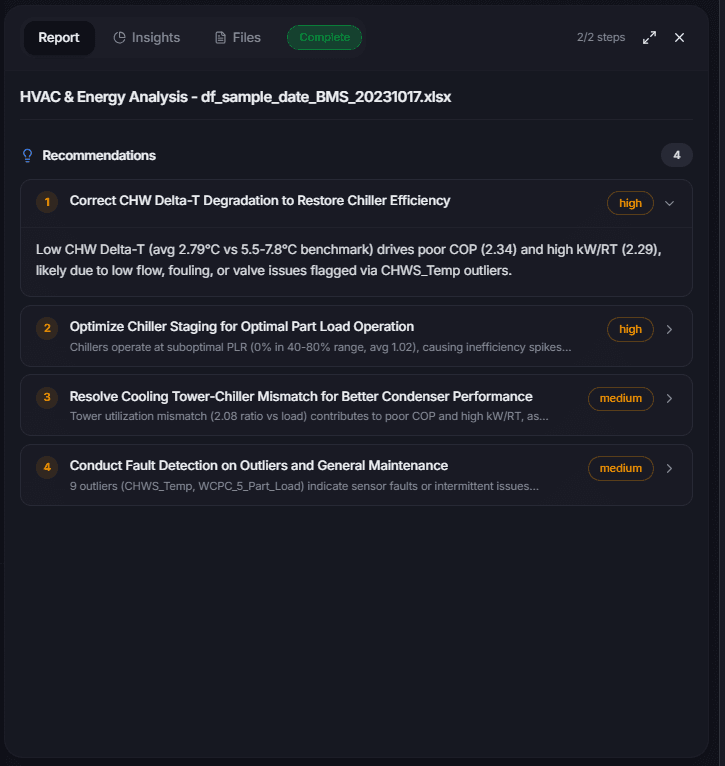
Prioritised AI Recommendations
The AI analyses your data against ASHRAE standards and generates actionable recommendations ranked by impact, complete with technical details and root cause analysis.
Correct CHW Delta-T Degradation to Restore Chiller Efficiency
highLow CHW Delta-T (avg 2.79°C vs 5.5-7.8°C benchmark) drives poor COP (2.34) and high kW/RT (2.29), likely due to low flow, fouling, or valve issues.
Optimise Chiller Staging for Optimal Part Load Operation
highChillers operate at suboptimal PLR (0% in 40-80% range, avg 1.02), causing inefficiency spikes during load transitions.
Resolve Cooling Tower-Chiller Mismatch for Better Condenser Performance
mediumTower utilisation mismatch (2.08 ratio vs load) contributes to poor COP and high kW/RT at partial loads.
Conduct Fault Detection on Outliers and General Maintenance
medium9 outliers (CHWS_Temp, WCPC_5_Part_Load) indicate sensor faults or intermittent equipment issues requiring investigation.
Conversational AI Interface
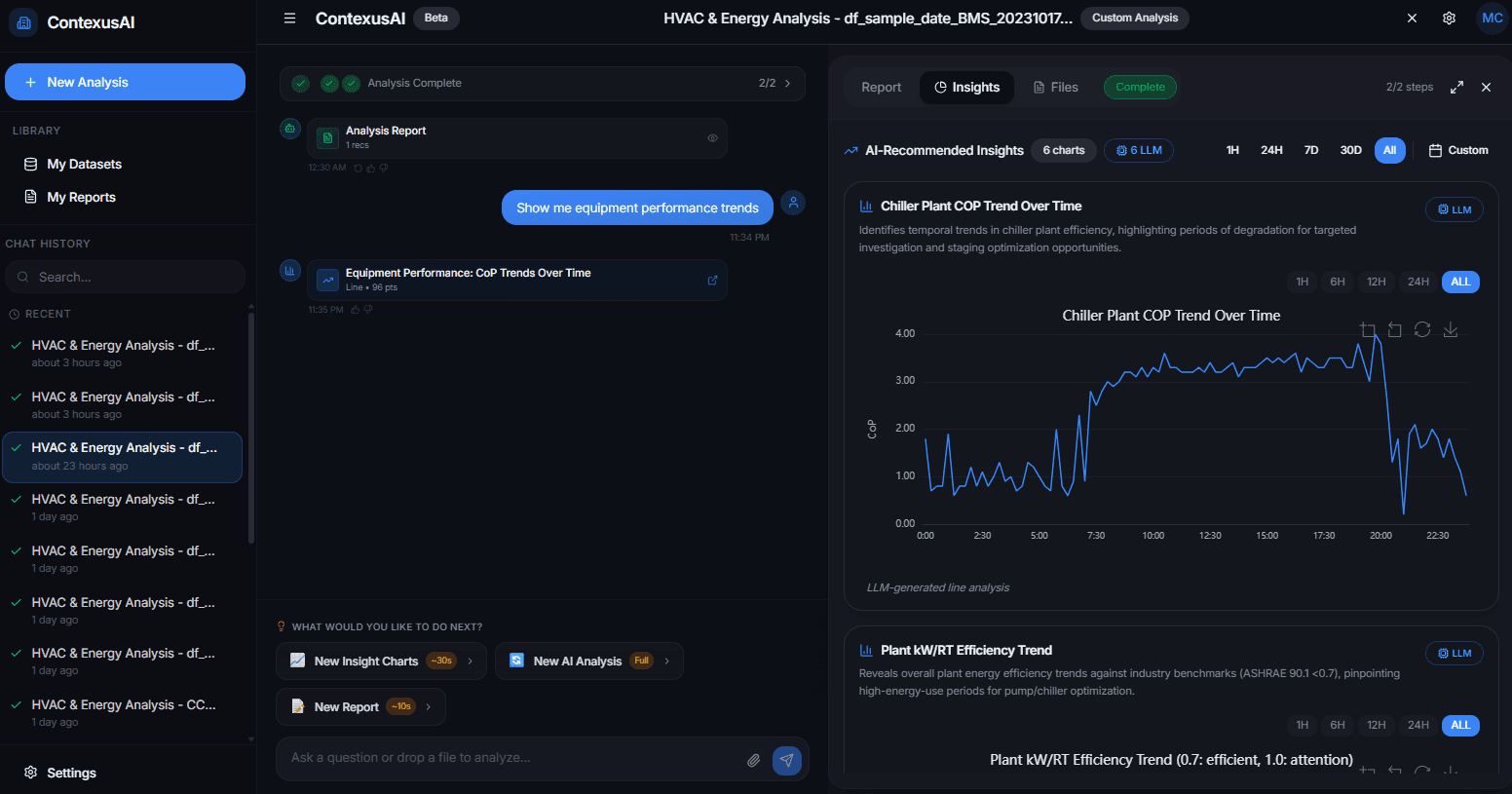
Ask questions about your data in plain English. The AI responds with relevant charts, insights, and follow-up suggestions. Build on previous analyses and drill deeper into specific findings with natural conversation.
- "Show me equipment performance trends"
- "Which chillers are underperforming?"
- "Generate a COP trend analysis"
- "Compare efficiency against ASHRAE benchmarks"
HVAC & Energy Analysis Reports
Upload BMS data exports and receive comprehensive analysis reports. The AI identifies optimisation opportunities for chillers, cooling towers, pumps, and air handling systems with specific technical recommendations.
Chiller efficiency tracking
Plant efficiency benchmarks
Heat transfer optimisation
Staging optimisation
AI Building Analytics Capabilities
LLM-powered building data analysis with ASHRAE benchmarking — turn raw BMS, IoT and meter data into clear, prioritised insight in plain English.
LLM-Powered Analysis
Advanced language models trained on building systems data provide natural language insights and recommendations specific to your equipment and operations.
Conversational AI Interface
Ask questions about your data in plain English. Get instant responses with charts, trends, and actionable insights without complex query languages.
Automatic Chart Generation
AI generates relevant visualisations based on your data: COP trends, efficiency curves, load profiles, and performance comparisons.
ASHRAE Benchmarking
Automatic comparison against ASHRAE 90.1 standards for chillers, cooling towers, pumps, and air handling systems. Identify underperforming equipment.
Prioritised Recommendations
AI-generated action items ranked by impact (high/medium/low) with technical details, root cause analysis, and specific optimisation steps.
Enterprise Security
SOC 2 Type II compliant with end-to-end encryption. Your data is never used for training and is automatically deleted after analysis.
Three Types of AI Analysis
Trend Analysis
Identify seasonal patterns, performance degradation, and long-term trends in equipment efficiency and energy consumption.
Performance Review
Benchmark equipment against ASHRAE standards with COP, kW/RT, and efficiency metrics. Compare performance across systems.
Anomaly Detection
AI-powered detection of sensor faults, unusual operating conditions, and equipment anomalies before they cause failures.
Advanced Analysis Capabilities
HVAC Optimisation
Chiller, AHU, and cooling tower analysis
Load Profiling
Understand building load patterns
Energy Waste Detection
Identify consumption anomalies
Predictive Insights
Forecast equipment degradation
Multi-Building Analysis
Compare performance across portfolio
Optimisation Scenarios
Model energy-saving interventions
Simple, Intuitive Interface
Get started in seconds. Just upload your data file and select an analysis type. No configuration required—the AI handles the rest.
Frequently Asked Questions
What file formats are supported for data upload?
CONTEXUS AI supports Excel (.xlsx, .xls) and CSV file formats. The system automatically detects column headers, data types, timestamps, and equipment identifiers. BMS export files from major manufacturers (Honeywell, Johnson Controls, Siemens, Schneider) are recognised and optimised for analysis. Maximum file size is 50MB, supporting datasets with millions of data points.
How does the AI generate insights from my building data?
The platform uses advanced Large Language Models (LLMs) combined with domain-specific training on HVAC, energy, and building systems data. After upload, the AI identifies equipment types, analyses temporal patterns, detects anomalies, and compares performance against ASHRAE benchmarks. Insights are presented in natural language with supporting charts and specific recommendations for optimisation.
What types of analysis can the AI perform?
Three core analysis types are supported: Trend Analysis identifies patterns, seasonality, and performance degradation over time; Performance Review benchmarks equipment against industry standards (COP, kW/RT, efficiency ratios) and identifies optimisation opportunities; Anomaly Detection flags outliers, sensor faults, and unusual operating conditions that may indicate equipment issues or energy waste.
Is my data secure and confidential?
Yes, enterprise-grade security protects all uploaded data. Files are encrypted in transit (TLS 1.3) and at rest (AES-256). Data is processed in isolated environments and never used for model training. Automatic deletion policies remove files after analysis unless you choose to save them. SOC 2 Type II compliance and regular security audits ensure data protection.
How do the AI-generated recommendations work?
The LLM analyses your data against ASHRAE standards and industry best practices, then generates prioritised recommendations ranked by impact (high, medium, low). Each recommendation includes technical details (e.g., CHW Delta-T deviation, COP values, kW/RT metrics), root cause analysis, and specific action items. Recommendations are actionable and can be exported for maintenance teams.
Can I have a conversation with the AI about my data?
Yes, the conversational interface allows natural language queries like 'Show me equipment performance trends' or 'Which chillers are underperforming?' The AI responds with relevant charts, insights, and follow-up suggestions. Chat history is preserved, allowing you to build on previous analyses and drill deeper into specific findings.