Mission-Critical Infrastructure Optimisation
Monitor power, cooling, and capacity across your entire data centre from a single platform — with the visibility needed to reduce PUE, prevent downtime, and plan for growth. Support Tier IV 99.995% availability requirements and cut operating costs through AI-driven cooling optimisation and predictive maintenance.
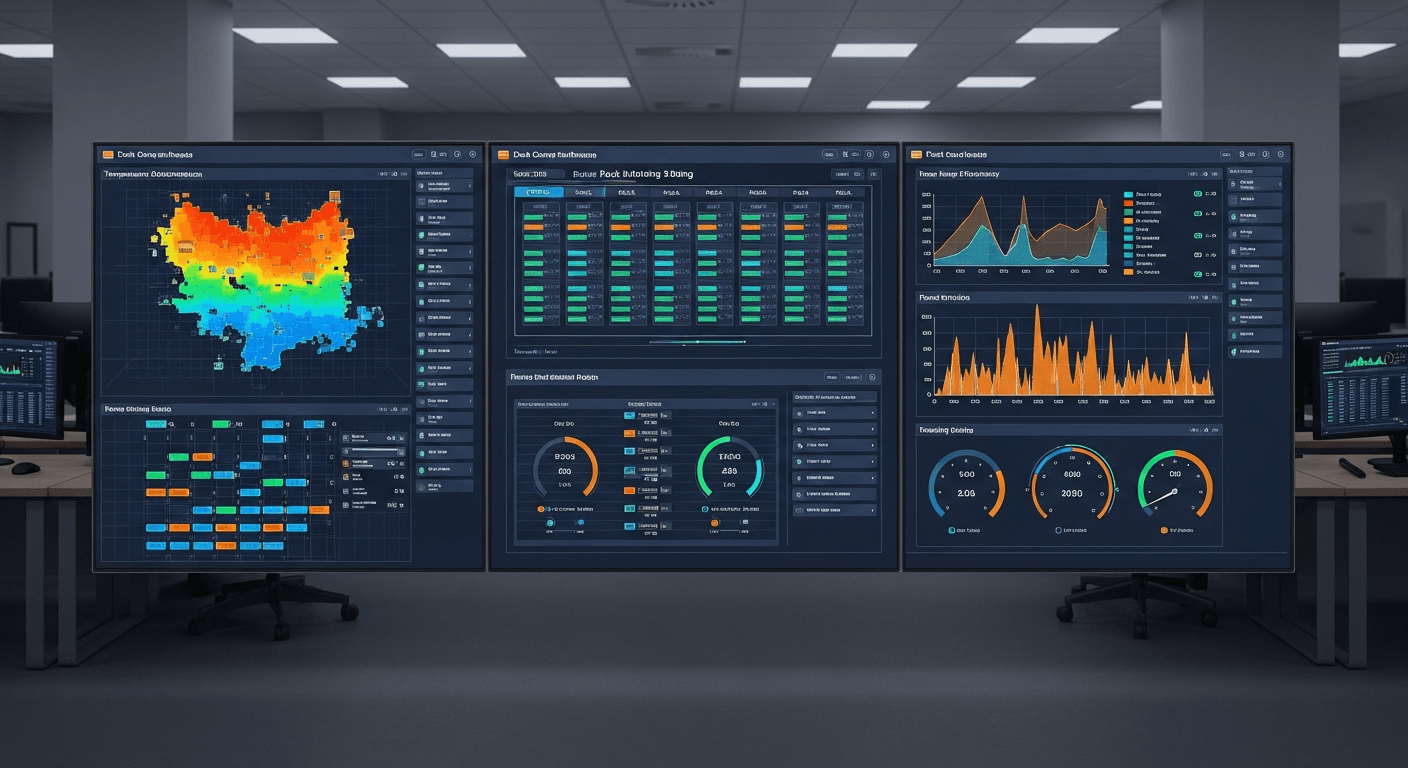
Complete Visibility from Rack to Facility
CONTEXUS DCIM provides unified real-time monitoring across power chains, cooling systems, and IT capacity — from facility-level PUE dashboards down to individual rack PDU readings.
- Real-time PUE tracking from 1.8 down to 1.2 with AI cooling optimisation
- UPS, generator, and CRAC/CRAH health monitoring with predictive failure alerts
- Hot/cold aisle containment visualisation and thermal hotspot detection
- Rack capacity planning: power, space, and cooling headroom per row
- SNMP, Modbus, BACnet, IPMI, and Redfish protocol support
Power Monitoring
Rack, row & facility-level power analytics
Cooling Optimisation
AI-driven CRAC/CRAH efficiency
Capacity Planning
Visual rack space & power headroom
Uptime Assurance
Predictive maintenance on critical infra
Data Centre Management Capabilities
Power Monitoring & PUE Optimisation
Real-time power monitoring at rack, row, and facility levels with PUE tracking from 1.8 to 1.2. Monitor UPS efficiency, generator fuel levels, and power distribution. Automated alerts for power anomalies and capacity threshold violations.
Precision Cooling Optimisation
AI-driven CRAC/CRAH control with predictive algorithms delivers significant cooling efficiency improvements. Monitor hot aisle/cold aisle temperatures, airflow patterns, and humidity levels. Automated adjustments prevent hot spots while minimising overcooling waste.
Environmental Monitoring
24/7 temperature, humidity, airflow, and water leak detection across data halls, equipment rooms, and MEP spaces. Early warning systems with multi-level alerts prevent equipment damage and support compliance with ASHRAE TC 9.9 guidelines.
Real-Time Infrastructure Health
Monitor UPS systems, PDUs, generators, chillers, pumps, and HVAC equipment health. Track runtime hours, maintenance cycles, and performance degradation. Automated health scoring identifies equipment at risk before failure.
Capacity Planning & Forecasting
Track power, cooling, and space utilisation with growth projections. What-if scenarios for new deployments assess power and cooling impacts. Prevent stranded capacity with optimised rack layouts and power distribution planning.
Physical Security Integration
Unified access control with biometric authentication, mantraps, and security zones. Video surveillance with motion detection and incident recording. Audit trails for compliance with SOC 2, PCI-DSS, and HIPAA physical security requirements.
Intelligent Alarm Management
AI-powered alarm correlation substantially reduces alert fatigue by filtering false positives and correlating related events. Priority-based escalation routes critical alarms to on-call teams via SMS, email, and mobile push. Automated ticketing integration with ServiceNow, Jira, and other ITSM platforms.
SLA Monitoring & Reporting
Track uptime, power availability, and cooling reliability against 99.99% or 99.995% SLA commitments. Automated monthly reports for customers with granular metrics. Real-time dashboards for NOC teams and executive stakeholders.
Predictive Maintenance
Machine learning algorithms predict equipment failures 30-90 days in advance based on operational patterns. Condition-based maintenance scheduling optimises technician productivity, helping reduce unplanned downtime and extend asset operational life.
Hybrid & Multi-Site Management
Unified dashboard for enterprise data centres, colocation facilities, and edge sites. Centralised monitoring with site-specific KPIs. Standardised operations across facilities while accommodating site-specific configurations and requirements.
Customer Portal & Multi-Tenancy
Colocation providers offer customers self-service portals with real-time power usage, environmental data, and work order status. Tenant isolation ensures data privacy. Branded white-label interfaces for premium service differentiation.
Asset Lifecycle Management
Track all infrastructure assets from procurement to decommissioning. Barcode/RFID integration for automated inventory. Warranty management, spare parts tracking, and depreciation schedules for financial planning and audit compliance.
Data Centre Type Applications
Enterprise Data Centres
Corporate-owned facilities supporting internal IT infrastructure and business operations.
- 500-5000 kW power capacity management
- Internal chargeback for business unit consumption
- Private cloud and on-premise application hosting
Colocation Facilities
Multi-tenant data centres providing retail and wholesale colocation services.
- Customer portal with real-time power and environment data
- Per-rack billing automation with meter data management
- SLA reporting and uptime guarantees (99.995%)
Hyperscale & Cloud Providers
Massive facilities supporting public cloud infrastructure and web-scale applications.
- 10-100+ MW power management and optimisation
- AI-driven cooling for millions of servers
- Multi-data hall and campus-wide orchestration
Edge Data Centres
Distributed facilities supporting low-latency applications and regional content delivery.
- Remote monitoring for 50-500 kW micro data centres
- Automated lights-out operations with minimal staff
- Centralised management across 100+ edge locations
Financial Services Data Centres
High-security facilities for banking, trading, and financial transaction processing.
- Tier III/IV design with N+1 or 2N redundancy
- Enhanced security and audit compliance (SOC 2, PCI-DSS)
- Ultra-low latency infrastructure monitoring
Government & Defense Data Centres
Classified and secure facilities with stringent compliance and security requirements.
- FedRAMP, FISMA, and DoD compliance monitoring
- Multi-level security zones with access segregation
- Air-gapped monitoring for classified networks
Business Value & Operational Excellence
PUE Reduction from 1.8 to 1.2 (30-40% Energy Savings)
AI-driven cooling optimisation and power management significantly improves power usage effectiveness. Typical facilities achieve meaningful reductions in energy costs within 12-18 months. ROI through energy savings alone typically pays for platform implementation in under 2 years.
99.995% Uptime & Downtime Prevention
Predictive maintenance identifies potential failures 30-90 days in advance preventing costly unplanned outages. Automated alerts and intelligent alarm management ensure rapid response to critical issues. Proactive maintenance significantly reduces unplanned downtime compared to reactive approaches.
30-50% Operating Cost Reduction
Automated operations reduce manual monitoring and intervention requirements. Optimised maintenance scheduling lowers labour costs. Energy efficiency improvements directly reduce utility bills. Capacity planning prevents overbuilding and stranded infrastructure investments.
Extended Equipment Lifespan 50-75%
Optimised operating conditions reduce thermal stress on IT equipment and cooling infrastructure. Predictive maintenance prevents premature failures. Condition-based servicing avoids unnecessary maintenance while catching issues early before damage occurs.
Real-Time Capacity Planning & Growth Support
Accurate tracking of power, cooling, and space prevents capacity surprises. What-if analysis tools model deployment impacts before committing resources. Prevent stranded capacity by optimising rack layouts and power distribution. Support business growth with data-driven infrastructure planning.
Compliance & Audit Readiness
Automated documentation for SOC 2, ISO 27001, PCI-DSS, and HIPAA audits. Comprehensive audit trails for access control, environmental conditions, and maintenance activities. Reduce audit preparation time with automated report generation and continuously maintained evidence collection.
Customer Satisfaction & SLA Guarantees
Transparent reporting builds customer trust with real-time power and environmental data access. Proactive communication of maintenance activities and service impacts. Predictive operations and redundant infrastructure monitoring support consistent delivery against Tier III/IV availability targets.
Sustainability & ESG Reporting
Track carbon emissions, water usage, and renewable energy percentage. Automated reporting for CDP, GRI, and SASB frameworks. Demonstrate corporate sustainability leadership with transparent environmental performance data. Support carbon neutrality commitments with accurate measurement and reduction tracking.
Infrastructure Integration & Compatibility
Building Management & Control Systems
Integration with BACnet, Modbus, SNMP, and proprietary protocols for UPS (APC, Eaton, Vertiv), PDUs, CRAC/CRAH units (Liebert, Stulz, Carrier), and generators. Automated failover testing and load balancing coordination.
IT Service Management (ITSM)
ServiceNow, Jira Service Management, and BMC Remedy integration for automated ticketing, change management, and incident workflows. Bi-directional synchronisation ensures infrastructure teams and IT operations collaborate effectively.
Monitoring & Analytics Platforms
Export data to Splunk, Datadog, Grafana, and Prometheus for advanced analytics. REST APIs enable custom integrations with business intelligence tools. Real-time data streams support machine learning and AI model development.
CONTEXUS Modules for Data Centres
A mission-critical suite for DCIM, energy intelligence, and infrastructure management.
Data Centre Standards & Compliance Frameworks
CONTEXUS supports documentation and monitoring for globally recognised data centre certifications.
Ready to Optimise Your Data Centre?
See how CONTEXUS DCIM can reduce your PUE to 1.2, eliminate unplanned downtime, and cut operating costs across your critical infrastructure.
Frequently Asked Questions
How can DCIM solutions reduce data centre operating costs?
DCIM platforms reduce data centre costs by 30-50% through AI-driven cooling optimisation that lowers PUE from 1.8 to 1.2, predictive maintenance preventing costly emergency repairs and downtime, real-time capacity planning avoiding over-provisioning, automated workload placement for optimal efficiency, and comprehensive energy monitoring identifying waste and optimisation opportunities across power, cooling, and IT infrastructure.
What is PUE and how low can it realistically go?
PUE (Power Usage Effectiveness) measures data centre efficiency by dividing total facility power by IT equipment power. A PUE of 2.0 means half the power goes to cooling and infrastructure. With smart DCIM solutions, most data centres can reduce PUE from typical 1.8-2.0 to 1.2-1.3 through precision cooling optimisation, hot/cold aisle containment, free cooling when possible, and AI-driven temperature management.
How does DCIM help prevent data centre downtime?
DCIM prevents downtime through predictive maintenance on critical infrastructure (UPS, generators, CRAC units), real-time monitoring of temperature, humidity, and power quality with instant alerts, automated failover testing and verification, capacity threshold warnings before limits are reached, and comprehensive asset tracking ensuring backup systems are ready. This level of monitoring is designed to support Tier IV 99.995% availability targets.
Can DCIM integrate with existing data centre infrastructure?
Yes, CONTEXUS DCIM solutions integrate with existing BMS, power monitoring systems, environmental sensors, CMDB and ITSM platforms, and hyperscale management tools. The platform supports standard protocols (SNMP, Modbus, BACnet, IPMI, Redfish) and provides APIs for custom integrations, allowing you to overlay advanced analytics without replacing functioning infrastructure.
What data centre types benefit most from DCIM solutions?
All data centre types benefit from DCIM: enterprise data centres reduce costs and improve reliability, colocation facilities optimise tenant billing and capacity planning, edge data centres enable remote monitoring and predictive maintenance, hyperscale facilities maximise efficiency at scale, and modular/containerised data centres benefit from standardised monitoring across distributed deployments.